
State Board or CBSE: Which Is Better for Scoring High Marks?
When it comes to the "high marks" debate, the answer isn't as simple as choosing one board over the other. The definition of a "good score" has evolved in 2026, especially with CBSE's shift toward competency-based learning and the varied scoring patterns across different State Boards.
If your goal is to see 95%+ on your marksheet, you need to understand how each board's "scoring engine" works.
1. CBSE: The "Science" of High Scoring
CBSE is often perceived as tougher because of its severity, but it is designed to be fair and transparent. For a smart student, this means the path to 95% is a predictable formula.
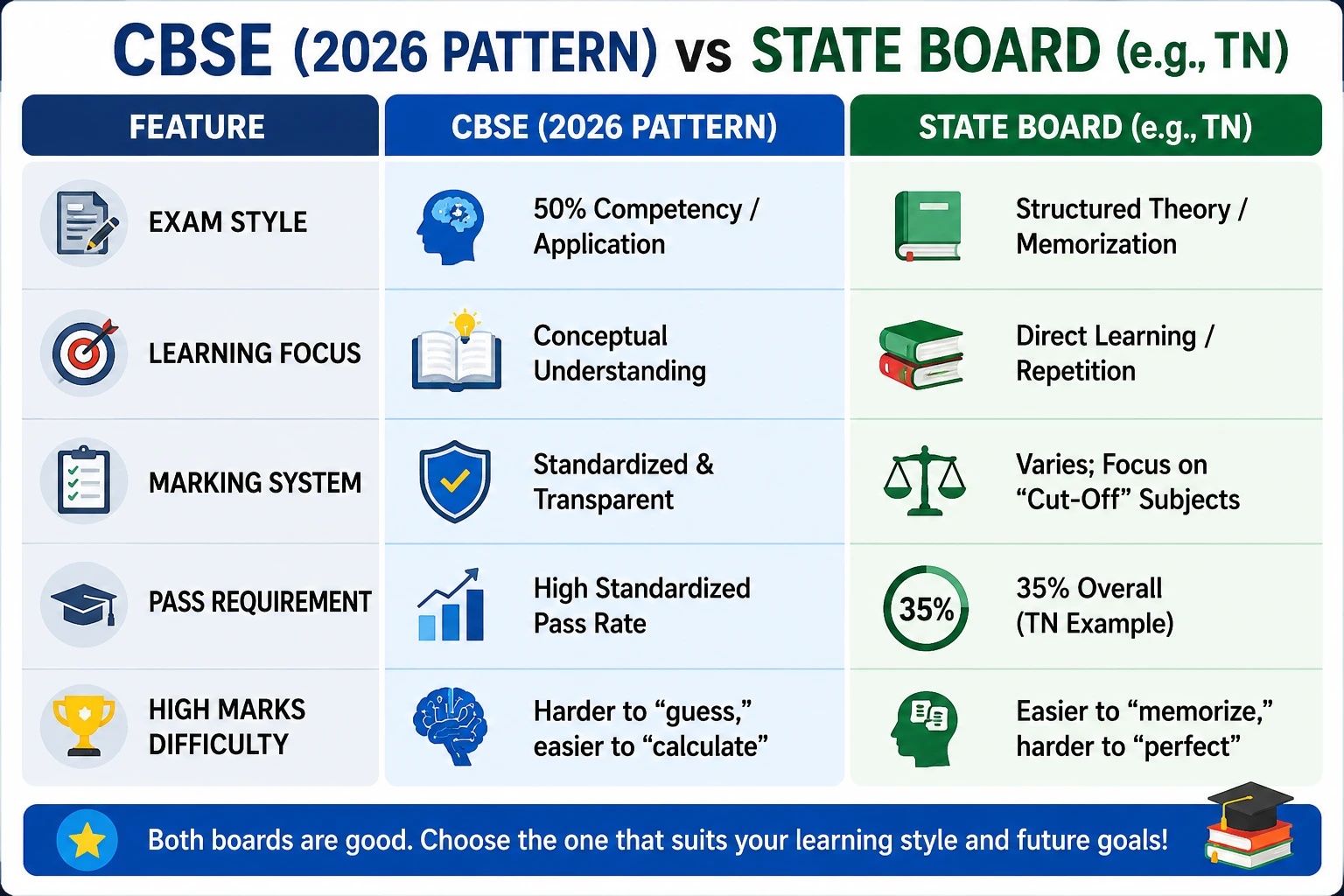
- Objective Advantage: In 2026, CBSE papers will include 20% MCQs and 50% competency-based questions. If you understand the concepts, these are "binary" marks—leaving no room for subjective bias.
- The 9-Point Grading System: CBSE uses a scale from A1 to E2. An A1 grade (the top 1/8th of passed candidates) signals you are a topper, whether your score was a 92 or a 98.
- Internal Boost: Most subjects have a 20-30% for the internal assessment component. Doing strong project work will likely secure these marks before taking the exam.
2. State Board: The Traditional Strategy (e.g., Tamil Nadu)
Historically, State Boards were considered "easier" because they relied on textbook memorisation, but many are now aligning with national standards.
- The TN Board "Numbers Game": In the Tamil Nadu State Board, your admission to top engineering colleges depends on a specific 200-point cut-off formula.
- Formula: Maths + (Physics\2) + (Chemistry\2) = Cut-Off.
- The Logic: Maths is counted fully, making it the "make-or-break" subject for high-ranking success.
- Subjective Marking: Unlike CBSE's objective-heavy papers, many State Boards still favour a structured mix of MCQs, 2-mark, 3-mark, and 5-mark questions.
- Local Advantage: State boards prioritise regional language and culture. Excelling in your mother tongue can significantly "pull up" your overall percentage.
Comparing the "Mark-Ability"
The Verdict: Which Should You Choose?
Choose CBSE for high marks if:
- You are good at problem-solving and logic.
- You want your 95% score to meet the requirements of JEE, NEET, or CUET.
- You prefer a board that rewards internal projects and practicals.
Choose State Board for high marks if:
- You want a less intense syllabus to focus on state-level entrance exams.
- You are comfortable with traditional descriptive exams and language-heavy scoring.
- You are aiming for a specific state engineering/medical rank.
The Bottom Line
In 2026, a 95% in CBSE is highly valued by national universities, while a 95% in a State Board might make you a "State Topper" with specific local benefits. Marks depend on your preparation style, not just the board's name.